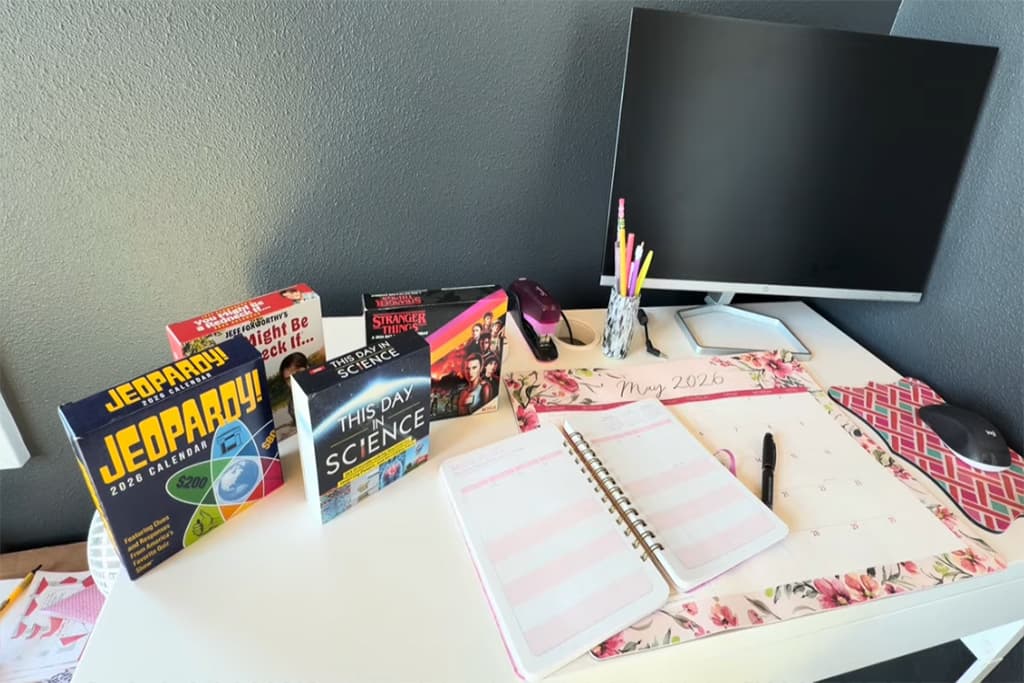
A desk calendar does one thing really well: it keeps your schedule in front of you without requiring you to unlock anything. No app, no notification, no password. You glance down, you see what is coming, and you get back to work. That sounds simple, but it is genuinely useful in a way that gets underappreciated until you actually try it.
For 2027, there are more formats to choose from than ever. Daily tear-off calendars, large desk pads, compact easel styles, and flip-style monthly views each fit a different kind of desk and a different kind of planner. If you want to see what is available now, browse the full 2027 calendar collection or jump straight to desk calendars to filter by format.
If you want to see different styles in action, watch our full video here: https://youtu.be/mTJdmEuzmGc
Keep Your Schedule Visible Without Opening an App
The biggest practical advantage of a desk calendar is visibility. Your meetings, deadlines, and reminders sit on the surface of your desk all day. You do not have to remember to check them.
This matters more than it sounds. Most people already have too many tabs open, too many notifications firing, and too many apps competing for attention. A desk calendar sits outside all of that. It does not ping you, it does not update itself, and it does not care whether your phone is charged. It just shows you what is happening today, this week, and this month.
Writing things down by hand also helps with retention. Physically putting a deadline on a calendar makes it stick in a way that typing the same thing into an app does not. That is not a productivity myth. It is just how memory works.
If you want maximum visibility, a desk pad gives you a full month across your entire desk surface. If you prefer something more compact, a small easel-style daily calendar keeps things vertical and out of the way.
Choose a Style That Matches How You Actually Work
Daily Tear-Off Calendars
Daily tear-off calendars are the most popular format we carry, and the reason is pretty straightforward: you get something new every morning. A joke, a puzzle, a fact, a quote. Whatever the theme is, it gives your desk a small reason to look at it. Titles like Far Side, 365 Cats, and 365 Brain Puzzlers are perennial best sellers because people genuinely look forward to the next page. The ritual of tearing off yesterday also works as a clean mental reset, which sounds small but adds up across a whole year.
Flip-Style Monthly Calendars
If you need to see the full month at once, a flip-style easel calendar keeps everything at eye level on a compact stand. Good for tracking project timelines, school schedules, or anything where you need to scan forward a few weeks without digging through a planner.
Desk Pads for the Office
Desk pads are the most practical format for a traditional office setup. They lay flat across your workspace in a standard 22x17 inch size and give you a full month of date boxes with open space for notes alongside them. They hold up well under gel pens and markers, and they double as a writing surface. If you share a desk or work from a home office and want your schedule visible at all times, a desk pad is hard to beat. Browse desk pads to see 2027 options by size.
Easel Calendars for Tight Spaces
Small desk? A compact easel desk calendar keeps things vertical so it barely takes up any surface space. Most fit comfortably beside a keyboard or under a monitor riser. They come in both daily and monthly formats depending on how much detail you want at a glance.
Pick a Theme You Will Actually Want to Look At
Organization works better when you enjoy your tools. That is not just a nice sentiment. It is the practical reason themed desk calendars outsell plain grid ones by a significant margin.
Humor
Funny desk calendars are a consistent top seller category, and for good reason. A bad afternoon is a little more manageable when there is a good Far Side panel sitting on your desk. Daily tear-off humor titles work especially well because the joke resets every morning.
Learning Something New Every Day
Informational desk calendars covering history, science, word games, and trivia are popular with people who want their desk to feel productive even during downtime. A daily brain puzzle or historical fact takes about thirty seconds and is genuinely more satisfying than scrolling your phone for the same amount of time.
Pop Culture and Entertainment
If your interests run toward movies, TV, music, or games, there are desk calendars for that too. Browse our Now Playing collection for entertainment-themed options, or explore the full calendar collection to find something that fits your taste.
Use Color Coding to Make Your Calendar Actually Useful
A plain grid with dates is fine. A grid where work meetings are blue, personal appointments are green, and deadlines are yellow is much faster to read at a glance.
You do not need a complicated system. Three or four colors is enough. Assign each to a category that matters to you, whether that is work, personal, school, or family, and use a highlighter or colored pen consistently. Add stickers for travel days or big events. Use checkmarks when things are done.
The goal is not to turn your calendar into an art project. It is to make the most important things jump out immediately when you look down at your desk.
Pro Tip: Keep your color system to three or four categories maximum. More than that and the whole thing starts to look cluttered, which defeats the purpose.
Small Desks and Shared Workspaces
Not every workspace has room for a full desk pad. If you are working from a small apartment desk, a dorm room, a shared office surface, or a kitchen counter, a compact standing calendar or mini calendar takes up almost no space while still keeping your schedule visible. Most small-format desk calendars fit in a rectangle about the size of a phone laid sideways, narrow enough to sit beside a keyboard without crowding it.
The format that works is the one that actually fits your desk. Measure the open space beside your keyboard before you buy, and go from there.
Pair a Desk Calendar With a Planner
A desk calendar and a planner solve different problems. The calendar shows you what is happening and when. The planner gives you space to break down how you are going to handle it. Using both together is a common setup for people who have a lot of moving parts: a monthly desk pad for the overview, a daily or weekly planner for the detail. If you want to explore planner options alongside your calendar, browse planners to see what formats are available for 2027.
Why Paper Still Works in 2027
Digital calendars are genuinely good at certain things: shared access, automatic reminders, syncing across devices. A paper desk calendar does not do any of that, and it does not try to.
What it does instead: it shows you the same information every time you look at it, without requiring any interaction. It works when your phone is dead, when you are in a meeting, when you have stepped away from your computer, when you just need to think. There is also something about the physical act of writing a date down, or crossing off a completed task, that feels more final than clicking a checkbox in an app. People who use both systems tend to use them for different things. The digital calendar handles logistics. The paper one is for thinking.
If you are ready to set up your desk for 2027, start with the 2027 calendar collection or go straight to desk calendars to find the format that fits your workspace.
